What is computational script coverage?
Computational script coverage is the automated ingestion and structural breakdown of standard screenplay formatting to produce analytical reports on dramatic timing, character prominence, and emotional momentum. In traditional studio development departments, human coverage readers evaluate hundreds of unproduced scripts each week, preparing summaries, character lists, commercial ratings, and structural critiques. Computational systems do not pass creative judgment on the ephemeral quality of wit or poetic subtext, but they parse every scene slug, action line, and parenthetical cue within seconds.
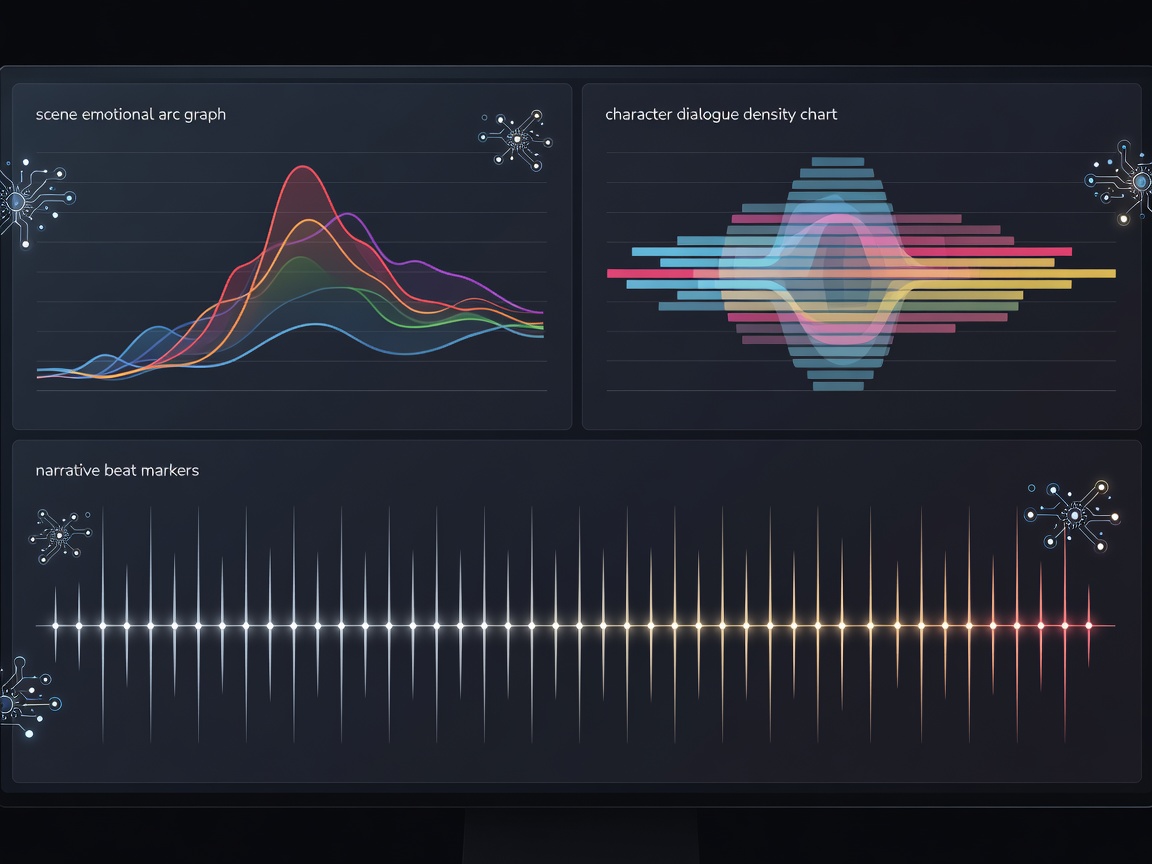
By transforming raw screenplay dialogue and action into semantic tokens, the software generates comprehensive graphs detailing narrative pacing. A development producer can instantly identify whether a second-act transition sags across twenty pages of exposition or if the central protagonist disappears from dramatic conflict for an extended sequence. This quantitative mirror allows writers and executives to examine their structural foundations before entering costly table reads and physical shooting.
How do natural language models assist screenwriters without replacing them?
Natural language models function as non-fatigued sounding boards and organizational cataloguers during the drafting process. When constructing extensive fictional worlds, multi-episode television arcs, or dense historical dramas, a writer must manage thousands of disparate continuity details. An author can query an analytical model to cross-reference dates, confirm character motivations established four scenes earlier, or suggest alternate vocabulary suited to a specific historical dialect.
Writers also employ computational text generators to overcome blank-page block during initial scene outlining. Rather than relying on machine-generated dialogue—which often trends toward generic idioms and predictable tropes—experienced dramatists prompt models to generate fifty disparate obstacles that might impede a protagonist's objective in a bank vault or courtroom. The writer then sifts through these machine permutations to spark genuine, idiosyncratic creative choices that would never emerge from a statistical median.
Can algorithms evaluate dialogue authenticity and character voice differentiation?
Yes, acoustic and lexical stylometry models can measure whether each character possesses a distinct rhythmic cadence, vocabulary breadth, and sentence complexity. A common structural flaw in early screenplay drafts is voice convergence, where every secondary character speaks with the exact syntax, wit, and linguistic patterns of the screenwriter. Natural language processing models evaluate dialogue blocks independently, plotting each speaker along axes of sentence length, grammatical formality, lexical diversity, and sentiment volatility.
If an elderly country physician and a rebellious teenage prodigy exhibit identical syntactical structures across three consecutive dialogue exchanges, the diagnostic tool flags the passage for authorial review. Screenwriters can then deliberately tweak punctuation, idiom selection, and sentence cadence to ensure distinct vocal separation across the cast ensemble.
How does narrative software forecast physical production costs directly from a script?
Narrative processing tools extract logistical parameters directly from scene headings and action descriptions to build instant physical production breakdowns. In conventional budgeting, a line producer manually reads every page of the script to highlight practical locations, interior versus exterior scenes, day versus night requirements, crowd count estimations, vehicular stunts, and required animal handlers. This laborious process takes days to prepare for a standard two-hour feature film.
Automated breakdown algorithms parse screenplay text to categorise required assets instantaneously. The system links scene elements directly to standard budgeting tiers:
- Location Clustering: Groups disparate scenes set in similar environments to minimize camera crew moves.
- Cast Continuity: Calculates the exact days a supporting actor is required on set, eliminating non-working retainer fees.
- Day/Night Ratios: Highlights costly night exterior sequences that demand extensive specialized lighting gear and nocturnal labor rates.
- VFX Tagging: Identifies action lines describing impossible physical events, allowing early visual effects budgeting before storyboard commissioning.
What are the primary ethical and legal constraints surrounding AI script analysis?
The primary constraints centre on intellectual property copyright eligibility, training corpus consent, and guild protections. Screenwriting guilds have established strict regulations ensuring that generative machine outputs cannot be credited as literary material or source material, preserving human authorship rights and residual compensation structures. Furthermore, production companies must ensure that proprietary screenplays uploaded into analytical engines are strictly quarantined within closed, non-training environments so sensitive story premises are not leaked or absorbed into publicly queryable foundation models.