What makes automated rotoscoping a major breakthrough for VFX houses?
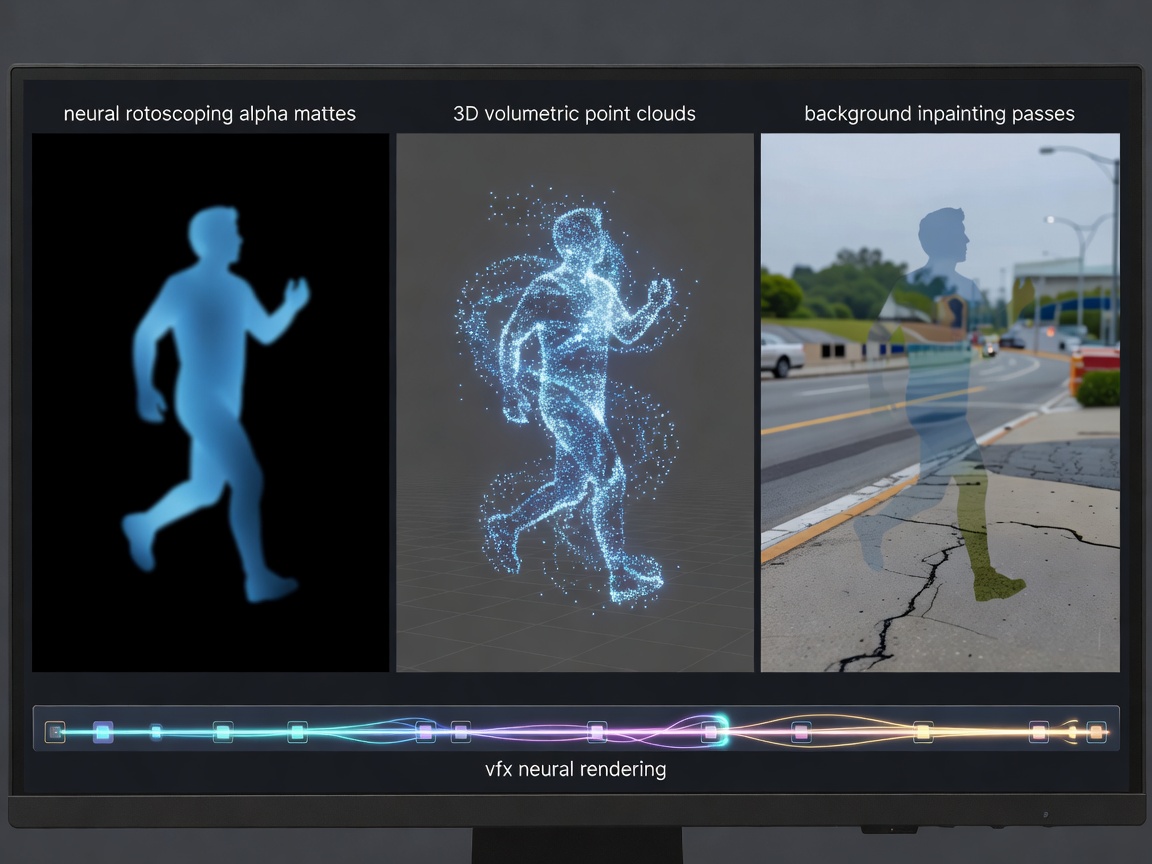
Automated rotoscoping replaces the frame-by-frame manual tracing of actors and objects with deep learning semantic segmentation models. Historically, isolating an actor from a live-action background when shot without a green screen required junior digital artists to hand-draw Bezier splines around hair strands, clothing folds, and fast-moving limbs across thousands of individual 24-frames-per-second exposures. This repetitive labour consumed massive portions of visual effects budgets and project schedules.
Neural segmentation architectures, trained on millions of annotated cinematic plates, predict object boundaries and motion vectors with pixel-level precision. When an artist isolates a subject, the model propagates matte boundaries across complex camera pans and turbulent focal blurs. The artist no longer draws every boundary from scratch; instead, they operate as a supervisor, fine-tuning edge softness, sub-pixel hair detail, and motion blur density, cutting weeks of baseline grunt work down to hours.
How does neural de-ageing differ from traditional computer graphics face replacement?
Neural de-ageing alters an actor's facial age by manipulating live-action pixel manifolds directly, rather than building a separate 3D geometric face model from scratch. In conventional CGI character modification, artists capture the performer's facial performance with marker dots, sculpt a high-density polygon mesh, paint detailed digital skin textures, simulate sub-surface light scattering, and manually match the digital double to the live lighting on set. If any parameter misses by a millimeter, the character falls directly into the unsettling uncanny valley.
Neural networks approach de-ageing through deep generative appearance transfer. By training an autoencoder or diffusion model on thousands of hours of historical footage of the same actor from their earlier film roles, the algorithm learns how that specific human face ages—how skin elasticity shifts, where volume reduces around the cheekbones, and how wrinkles interact with authentic muscular smiles. When applied to the new performance, the network adjusts facial features directly on the live footage, preserving 100% of the actor's organic eye movements, micro-expressions, and intimate pupil dilations.
What role do Neural Radiance Fields (NeRFs) and Gaussian Splatting play in environment design?
Neural Radiance Fields and 3D Gaussian Splatting allow visual effects teams to transform ordinary two-dimensional location photographs into fully navigable, photo-real 3D volumetric environments. Traditionally, recreating a real-world cathedral, mountain pass, or urban alleyway required complex photogrammetry, manual polygon reconstruction, texture unwrapping, and time-intensive ray-traced lighting passes. When the virtual camera moved too close to an edge, textures stretched and broke down.
NeRFs and Gaussian Splatting capture how light rays travel through space continuously. A drone or technician captures a series of still photographs around a location, and a neural network optimizes a volumetric representation that understands complex lighting reflections, semi-transparent glass, water puddles, and microscopic foliage details. Directors can then place a virtual cinematic camera anywhere inside the captured volume, moving at any focal length, with perfect view-dependent specular reflections and atmospheric depth.
How is generative inpainting used in wire removal and scene clean-up?
Generative inpainting synthesises missing visual information behind removed stunt rigs, microphone booms, safety harnesses, and unwanted background elements. In action filmmaking, actors routinely hang from steel cables or leap across padded platforms that must be painted out frame by frame. An artist traditionally had to construct clean plates by cloning textures from surrounding still frames, adjusting for grain, camera motion, and shifting light values.
Deep neural inpainting networks analyze temporal coherence across adjacent video frames to infer what was genuinely obscured behind the wire or rig. The model reconstructs natural architectural patterns, shifting brickwork shadows, or dynamic rolling ocean waves with identical optical grain and lens aberration. This automated clean-up ensures that practical stunt work remains fast and safe on set, knowing digital eradication is swift and seamless in post-production.
What are the primary technical trade-offs between neural rendering and traditional ray tracing?
The primary trade-off lies between deterministic optical accuracy and computational synthesis flexibility:
- Artistic Controllability: Ray-traced 3D pipelines allow lighting technical directors to move a single virtual light source by two degrees and adjust a reflection shadow predictably. Neural models operate on statistical latent spaces, making surgical minor corrections challenging without altering adjacent pixels.
- Render Times: Ray tracing physical photons across billions of polygons demands immense server farm hours. Neural inference generates complex imagery in near real-time once the weights are optimized.
- Resolution Stability: Traditional renderers can scale cleanly to 8K IMAX projection without resolution artefacts. Neural upscaling must carefully mitigate hallucinated details or temporal flickering across high-contrast edges.