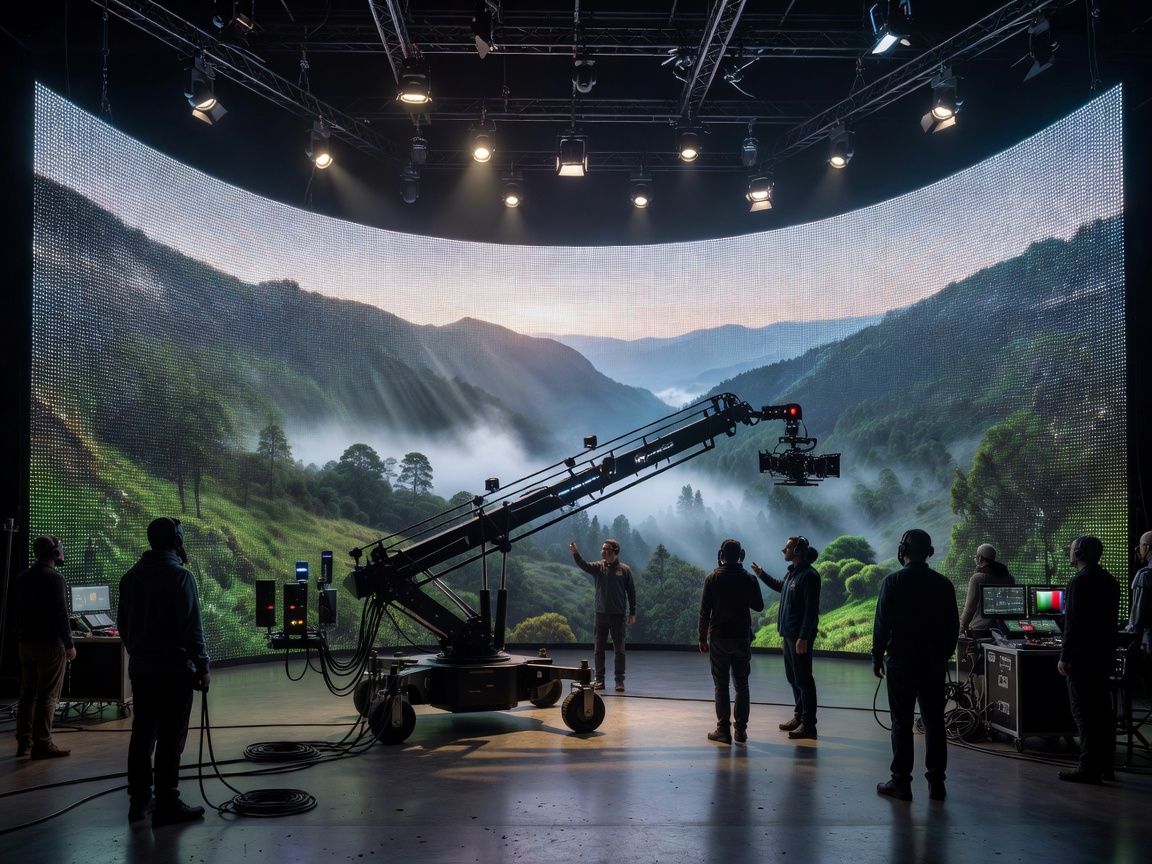
What is a virtual production LED volume?
A virtual production LED volume is an enclosed soundstage wrapped in ultra-high-definition LED wall and ceiling panels that display real-time, photorealistic 3D backgrounds behind physical actors. Pioneered in modern sci-fi and fantasy filmmaking, this technology replaces traditional green screens. Because the LED panels emit genuine light, they cast natural, physically accurate reflections onto actors' skin, practical props, costume fabrics, and reflective vehicle glass, completely eliminating the green spill that plagued post-production compositors for decades.
Crucially, the perspective displayed on the LED wall is driven dynamically by the physical camera's position in the room. As a camera dolly moves to the left, the rendered background shifts its parallax instantly, creating the convincing illusion that the live performers are standing inside an infinite alien desert, medieval castle, or bustling urban metropolis.
How do machine learning algorithms eliminate camera tracking latency?
Machine learning models eliminate tracking latency by predicting physical camera trajectories several frames into the future. When a physical camera swings rapidly across a crane arm, traditional optical and inertial tracking sensors transmit positional coordinates to the real-time graphics rendering engine. However, the calculation of complex 3D geometry and ray tracing introduces unavoidable computational delay, resulting in perceptible lag where the background sloshes behind the physical camera motion.
Predictive neural networks solve this problem by continuously analysing the operator's velocity, acceleration, hand tremors, and historical panning patterns. The network accurately predicts where the camera sensor will be positioned 16 to 33 milliseconds in advance, allowing the rendering engine to render the correct perspective before the camera physically arrives at that exact coordinate in physical space. This eliminates visible latency and keeps the parallax perspective locked.
How do dynamic lighting systems synchronise with rendered virtual skies?
Dynamic lighting systems employ computer vision to analyze the rendered digital sky on the LED ceiling and adjust physical motorized stage fixtures automatically. On a traditional film set, matching the intensity and color temperature of a setting sun or sudden lightning flash required lighting technicians to adjust dimmer boards manually by eye, often requiring numerous takes to achieve sync with background action.
In an AI-orchestrated volume, the virtual sun's position, cloud occlusions, and atmospheric haze values are parsed directly from the game engine's environmental parameters. The system automatically sends DMX signals to robotic lighting instruments suspended above the stage, ensuring that if a digital explosion detonates behind the digital mountains on the LED wall, warm orange illumination strikes the physical actors from the exact corresponding angle with sub-millisecond precision.
What is generative pre-visualisation (previs) and how does it compress pre-production?
Generative pre-visualisation is the rapid algorithmic creation of 3D animatics, camera angles, and storyboard choreography before building physical sets or hiring crew. Historically, producing a previs sequence for a major action sequence took a dedicated animation team months to model rough polygonal characters, block vehicle trajectories, and render low-detail camera passes.
Modern production teams use multimodal models to transform rough sketches, director voice notes, and script pages directly into spatial scene layouts. Directors can audition dozens of lens focal lengths, camera heights, and blocking strategies on a tablet device in real time, locking the visual grammar of a complex sequence before committing substantial financial capital to physical construction.
What are the main operational challenges when running real-time neural sets?
Running high-end virtual production stages presents distinct technical trade-offs:
- Thermal and GPU Load: Sustaining synchronized multi-camera 4K rendering across dozens of linked graphics processors generates massive heat and requires enterprise-grade cooling infrastructure on set.
- Moiré Pattern Mitigation: When a digital camera sensor's pixel grid aligns directly with the LED panel pixel matrix, optical interference patterns emerge; neural filtering passes are required in-camera to blur these artifacts without softening live-action details.
- Calibration Precision: Slight shifts in lens calibration, sensor temperature, or focal length require continuous algorithmic recalibration throughout an intensive 12-hour shooting day.